Self help: Mockingbird youth are leading advocacy efforts by the Mockingbird Society

Mockingbird Society

Photo: Jerry Davis

“For the young people at The Mockingbird Society who have experienced homelessness and foster care, advocating for the youth of the next generation is imperative.

‘Even as I’m going through this journey of being homeless, I’m teaching, I’m inviting people in and changing people’s lives,’ said Okesha Brandon, a youth advocate. ‘Everyone kind of learns your strengths and people notice, and it builds your confidence. That in itself is a contribution to society.’

Named after the great American novel “To Kill a Mockingbird,” the organization draws inspiration from the book’s narrative.

“The power and promise of ‘To Kill a Mockingbird’ is in reminding each of us of the untapped potential our most vulnerable citizens hold,” states the organization’s website.

In the seventeen years since its founding, The Mockingbird Society has had a hand in 25 new laws and reform policies to better the lives of young people in Washington state. Mockingbird’s youth programs train young people who have been homeless or in foster care to be their own best advocates. The result? Changes in the policies and perceptions that stand in the way of every child having a safe, stable home and a healthy family.

Mockingbird’s legislative agenda for 2017 is ambitious, but already making an impact.”
READ THE FULL STORY ON REAL CHANGE

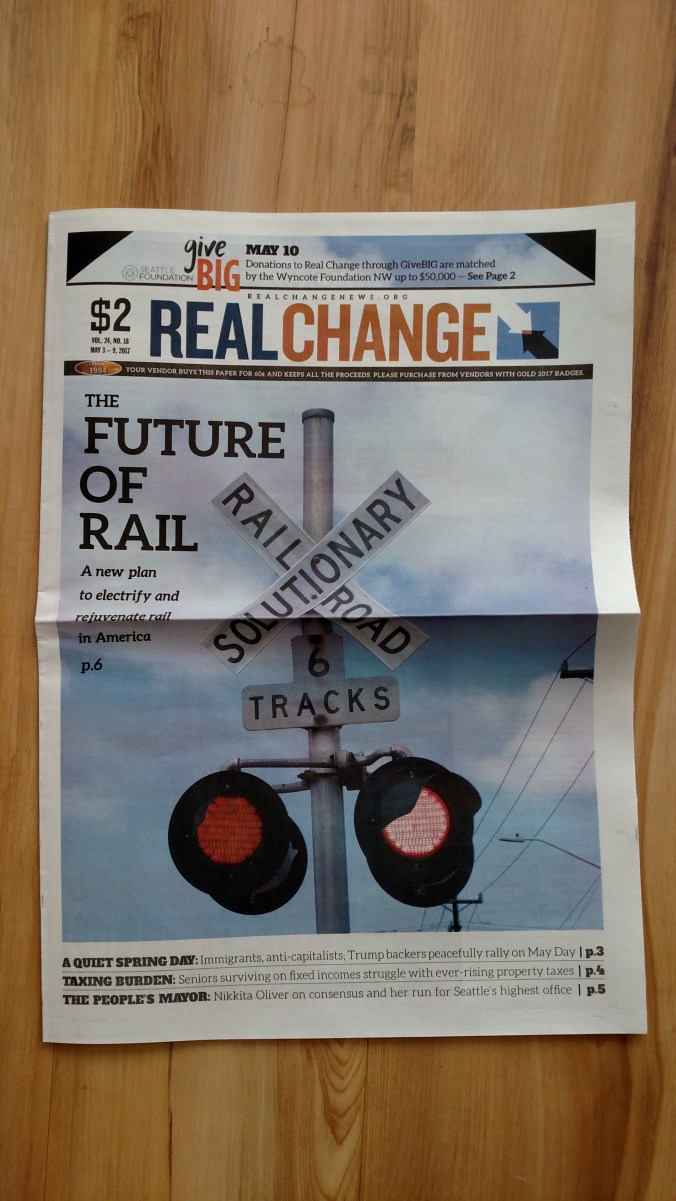
Backbone Campaign’s people-powered plan to electrify America’s railroads

IMG_20170503_145538674

“In our fractured political climate, it’s hard to envision a cause that could unite a rural farmer with a big-city tech worker, a union laborer with a grassroots environmentalist, or a tribal leader with a government official, but Bill Moyer thinks he’s found just the cause: Solutionary Rail.”

Solutionary Rail proposes that the public electrify America’s railroads, run them on renewable energy and transform railroad corridors into electricity superhighways transmitting wind and solar energy from remote rural areas to urban centers. If enacted, Moyer said the proposal would recenter the role of rail in U.S. transportation and provide the public with a new sustainable source of economic vitality.

In other words, with Solutionary Rail, everybody wins.

“It provides almost a psychic relief from the burden of being defined by what we oppose,” said Moyer, who serves as executive director of the Washington state-based Backbone Campaign, a nonprofit that creates “artful activism.” “This offers an opportunity to be for something great, to be in dialogue with communities that we may not have anything else otherwise in common about some shared interest.”

img_20170503_145551690-e1493849723820.jpg

Excited to share my first story for Real Change. Real Change is an award-winning weekly newspaper that provides immediate employment opportunity and takes action for economic, social, and racial justice. If you live in Seattle, pick up a paper from your local vendor this week!

READ THE FULL STORY ON REAL CHANGE

Maria Bamford Wants You to Know You’re Doing Great

maria-bamford

In her sublime new Netflix standup special, Old Baby, premiering on May 2nd, Maria Bamford performs a comedy set in increasingly larger venues. What begins as a few jokes in front of a mirror, progresses to a living room, onto a bowling alley, and so on, until she goes out with a bang on a big stage. The special is sparkling, her jokes are original, and her audience grows more hysterical with laughter as the size of the performance venue expands and shrinks. She is truly magnificent.

Maria Bamford is my favorite comedian. I admire everything she stands for as a comic and as a human being, and told her so in stream of barely intelligible gushing at the beginning of our interview. I rarely find myself star struck these days, but Bamford is special. Her comedy has served as somewhat of a lifeline to me during particularly dark times, and I was determined to repay her with a good interview. My enthusiasm was profuse and unsettling, but she accepted it with grace. Stephen Colbert may have proclaimed her to be his favorite comedian on planet earth, but she is my favorite comedian in the history of the universe and I wasn’t going to miss an opportunity to express my sincere gratitude and adoration.

I asked Bamford several relevant questions about her comedy special, but then, throwing caution to the wind, I dove in with the 36 questions. If you’re not familiar, the 36 questions refer to a study by the psychologist Arthur Aron (and others) that explores whether intimacy between two strangers can be accelerated by having them ask each other a specific series of personal questions. I had recently read Mandy Len Catron’s Modern Love essay, “To Fall in Love With Anyone, Do This,” and thought if there was ever a moment to accelerate intimacy, this interview was it. I asked Bamford if she’d heard of the 36 questions. She had. With genuine excitement she exclaimed, “let’s fall in love!” And we did. Or at least I did. Again.

READ THE FULL INTERVIEW IN VULTURE

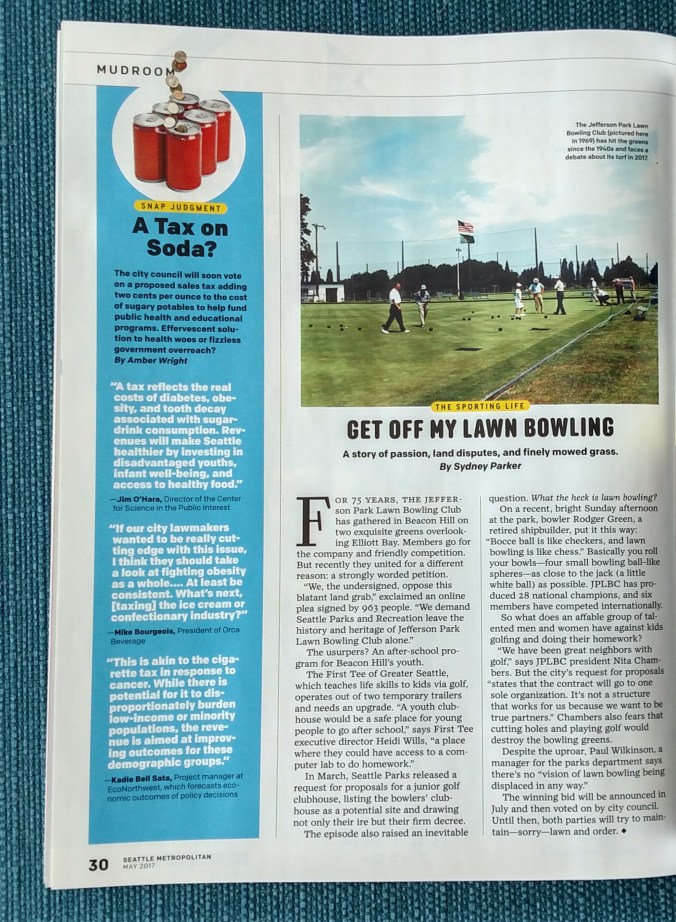
Seattle’s Lawn Bowlers Aren’t Going Down without a Fight

Jefferson Park Lawn Bowling Club

“For 75 years, the Jefferson Park Lawn Bowling Club has gathered in Beacon Hill on two exquisite greens overlooking Elliott Bay. Members go for the company and friendly competition. But recently they united for a different reason: a strongly worded petition.

‘We, the undersigned, oppose this blatant land grab,” exclaimed an online plea signed by 963 people. “We demand Seattle Parks and Recreation leave the history and heritage of Jefferson Park Lawn Bowling Club alone.’

The usurpers? An after-school program for Beacon Hill’s youth.”

IMG_20170421_144454145_HDR.jpg

READ THE FULL STORY IN SEATTLE MET MAGAZINE

Daniel Pak’s Mission to Share Music

2017-0220-pak-family-music-sc0003-34e42287

Photo: Joshua Huston

“Growing up on the Hawaiian island of Oahu, Daniel Pak knew that music was in his blood. His father was a jazz pianist and taught him to play scales around age 6. In a few years, he had advanced to performing pieces by Mozart and Beethoven. But it wasn’t until he taught himself acoustic guitar at 13 that his passion was truly ignited. “That’s when I really found that music was more than just lessons. Music was something that would be with me every day,” says Pak.

Pak has fond memories of kanikapila, impromptu music jam sessions with friends. “We’d all go to the beach. Someone would bring ukuleles and guitars, someone would bring bongos. We’d play music and listen to the waves coming in and the palm trees rustling,” says Pak.  Today — minus the beach, palm trees and crashing waves — Pak tries to “perpetuate that tradition here in Seattle.” 

READ THE FULL ARTICLE IN SEATTLE’S CHILD

Making the Perfect Seattle Rain Jacket

freeman_grey_2016_harbor_island-0

Photo: Freeman

“On a quest to find the perfect Aloha shirt? Look no further than Hawaii. When you need a sturdy pair of cowboy boots, Texas is your one-stop shop. And if raindrops keep falling on your head, Seattle Freeman raincoats have got you covered.

Accustomed to a consistent drizzle, Seattle residents embrace the rain as part of what keeps the trees evergreen, the water shimmering, and the coffee-shop book-reading a preferred activity. Seattle had a record-breaking ten inches of rainfall this October, but that doesn’t mean we were any more inclined to carry umbrellas. They’re cumbersome! Raincoats though, well, that’s another story.

The tale of the perfect Seattle raincoat begins not with The Cat in the Hat, but with Brittany and Scott Freeman. The Freemans met at a party in Bellingham while attending Western Washington University. They fell in love and married, and certainly didn’t foresee that one day they would be in the raincoat-making business. Scott was a carpenter, deft at engineering cabinets and woodcarving. Brittany worked full-time in the corporate arena, sewing as a hobby on the side.”

READ THE FULL ARTICLE ON RACKED HERE

Christmas Otter delivers mischievous cheer

2016-1105-december-holiday-issue-sc0265-befaded0

“While Rudolph guides the sleigh and Santa slides down the chimney in other households, an unusual visitor makes mischief at the Finks’ house. 

But that wasn’t always so. 

In the past, Marian and her wife, Shane, along with their daughter, Asa, traveled to the East Coast to celebrate Christmas with extended family. Because of work obligations, they were flying into New Jersey on Christmas Eve just in time for a seven-course dinner. 

“It’s a massive feast that goes on till midnight,” says Marian. “The menu changes, but there’s always lobster, clams, shrimp and lasagna.”

Two years ago, the couple had a second daughter, Maeve. Shortly after, they decided to opt out of the hectic holiday travel that year and celebrate at home in Seattle’s South Park neighborhood. Without all the magic and hullabaloo of the caravan back East, the Finks wanted to create a special tradition just for their family of four to share at home. 

Shane had an idea. Growing up, she’d always had a special relationship with stuffed animals and — for better or worse — continued to amass a substantial collection of them into adulthood.”

READ THE FULL STORY IN SEATTLE’S CHILD

A season (and lifetime) of giving

2016-1105-december-holiday-issue-sc0184-39d24b2b

The Thurman Family. Photo: Joshua Huston

“Joy Thurman might just be the busiest woman in Seattle this holiday season. 

Joy is a fourth-year medical student at University of Washington, a mother of a 3½-year-old daughter and expecting a new baby any second (if she or he hasn’t already arrived). When she’s not hitting the books or working at Harborview, she volunteers at the White Center food bank with her father, her husband, and daughter Andersyn. 

“I always get the most out of the work I don’t get paid for,” says Joy. When Andersyn was old enough to stand and hold things on her own, she joined her mom at the food bank, standing up on milk crates to give out cans. 

“She loves going to the food bank, and everyone always really enjoys having her there,” says Joy. The family volunteers year-round, including the holiday season. 

Born and raised in South Seattle, she met her husband, Nic, a neonatal intensive-care unit nurse, while attending Western Washington University in Bellingham. The couple celebrates Christmas in the culinary traditions of their blended family. Thurman is half African American, half Filipino, and her husband is Vietnamese American.”

READ THE FULL STORY IN SEATTLE’S CHILD

How to Talk to Your Kids About Bullying

2016-1001-feature-guardian-adam-sc0041-9dffe916

Adam Wenzel. Photo: Joshua Huston

We can all conjure an image of a bully, drawing from TV shows and movies like Back to the Future, Mean Girls and A Christmas Story (poor Ralphie!). But the truth is, bullying is not a normal, inevitable part of childhood. It’s a serious deviation. Gone are the days of dismissing repeated, aggressive behavior among school-aged children as merely kids being kids. 

Decades of research have taught us that children who are bullied — as well as those who inflict the bullying — often suffer anxiety, depression, poor academic performance and physical ailments, and are at a higher risk for substance abuse and a wide range of other health problems in adulthood.

Committee for Children, a Seattle nonprofit, is working to prevent bullying through a social-emotional learning program being taught to 80,000 Puget Sound-area students at 130 schools. 

‘It’s not just about making kids better, it’s about working with adults and an entire community to create a climate where bullying is not the norm, not tolerated, not OK,’ says Mia Doces, director of the New Mission Ventures program at the committee. 

No parent wants to discover that their child is getting pelted in the head every day on their morning bus ride or eating lunch in the bathroom to avoid taunting in the cafeteria. But if you don’t ask, you may never know. Many kids either don’t recognize that it’s a problem they should report, or they feel too ashamed to tell someone they trust.” 

READ THE FULL STORY IN SEATTLE’S CHILD

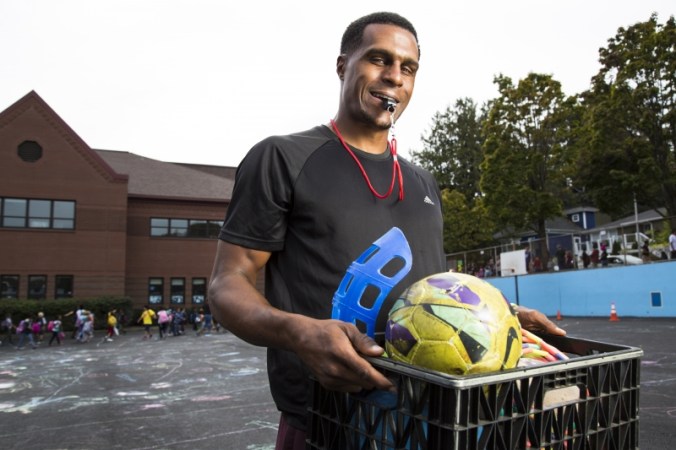
Gabriel Rapier Champions Futsal for All

2016-0917-october-mr-recess-feature-sc-0063-e41140f5

Gabriel Rapier. Photo: Joshua Huston

“Gabriel Rapier could really use a roof. Nothing fancy, just a simple shelter so the kids he coaches in Seattle’s Central District can come play at Judkins Park, rain or shine. He swears they only need it for the rain, but watching the kids guzzle water on a sweltering summer day, it was clear they could use it for the shine, too.

But Rapier won’t let a little inclement weather stop him from making positive change in his community. He’s resourceful. Recognizing a need for an affordable alternative to expensive youth premier soccer leagues, he co-founded Puget Sound Futsal 10 years ago. Futsal is a sport similar to street soccer, but with a heavier ball on an enclosed hardtop. It can be played indoors or outdoors, and has short, narrow goals and five players per side.”

READ THE REST IN SEATTLE’S CHILD MAGAZINE